
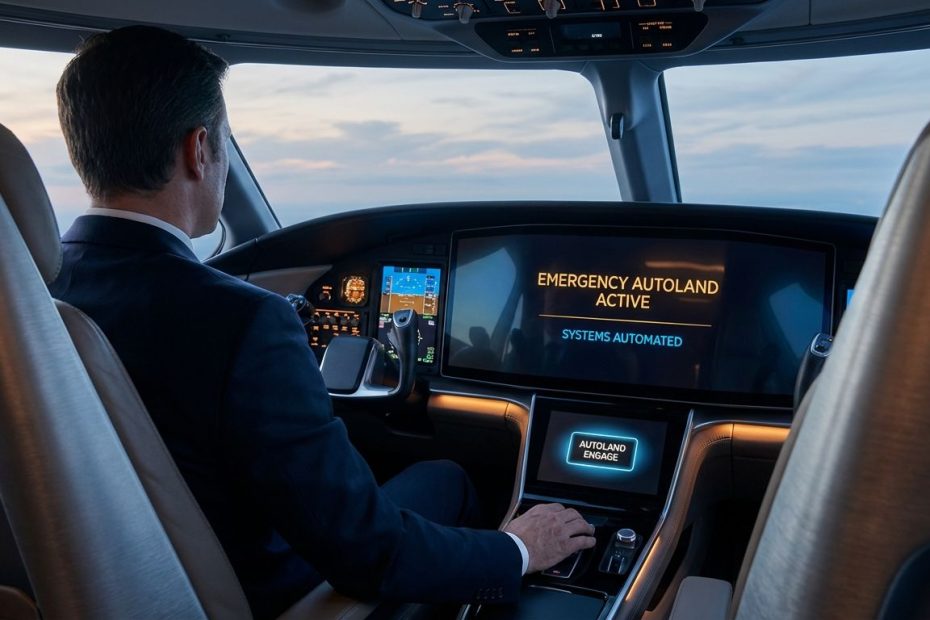
Private aviation is moving from a hiring-and-retention problem toward a technology-and-operations problem: you will still need pilots for a long time, but you will also operate aircraft that can increasingly protect, manage, and even land themselves when the crew can’t. The near-term future is not “no pilot,” it’s “less workload, fewer failure modes, and tighter dispatch reliability,” driven by certified automation, regulator-approved operating concepts, and insurance reality.
You will get a practical read on what’s real today, what’s getting certified now, and what’s still blocked by rules, liability, and proof. This article will answer the exact questions owners, operators, chiefs, and flight departments keep asking, then translate the answers into decisions you can make on fleet plans, training, avionics upgrades, and staffing. Expect direct talk on single-pilot operations, emergency autonomy, FAA rule changes, and why air-taxi certification work matters to your next aircraft purchase even if you never plan to fly an eVTOL.
Will Private Aviation Actually Run Out Of Pilots, Or Is The “Pilot Shortage” Overhyped?
You should treat “pilot shortage” as a segmented, cyclical staffing pressure, not a permanent condition that guarantees ever-rising wages and endless job openings. Airline hiring cooled back toward pre-2019 patterns, and that changes the gravitational pull airlines usually exert on Part 91 and Part 135 cockpits. When major-airline hiring slows, business aviation stops bleeding experienced crews as fast, and upgrade timelines stop moving at the same speed.
The data point that matters for your planning is not a headline, it’s hiring volume and trend. AOPA, citing FAPA, reported major airlines hired 4,834 pilots in 2024 versus 12,196 in 2023, and 13,128 at the 2022 peak, plus January–February hiring showed a year-over-year drop. Those numbers reduce the “immediate emergency” narrative, yet they do not remove your operational risk, because private aviation staffing pain is rarely uniform across fleets, bases, duty models, and pay bands.
Your real exposure sits in the places the public rarely separates: hard-to-staff domiciles, high-utilization fractional schedules, medevac rotations, and owner-flown operations that outgrow “friends and favors” staffing. Even in a cooler hiring cycle, you still face training bottlenecks, attrition to better quality-of-life bids, and the simple math that retirements keep happening. AOPA noted retirements were expected to peak around 2026–2027, which keeps upward pressure on the system even when hiring pauses.
So the smart question is not “Is there a shortage,” it’s “Where is the shortage in the exact missions you run.” If you operate turbine aircraft with demanding duty schedules, you still benefit from any technology that reduces workload, reduces training churn, and increases completion rates. That is why serious operators invest in automation even when applicant flow improves, because staffing is only one line item inside dispatch reliability.
What Private-Aviation Tech Is Already “Pilotless” Today, And What’s Still Not There?
Today’s “pilotless” capability in private aviation is best understood as certified emergency autonomy and workload-reducing automation, not routine passenger service with no pilot aboard. You can already buy and operate systems designed to stabilize the aircraft, manage energy, and autonomously land in a pilot-incapacitation scenario. That is a real, operationally meaningful form of autonomy because it solves a specific safety problem with a bounded operating concept.
Garmin’s Autoland is the most visible example because it’s built for a scenario you can explain to owners, underwriters, and regulators in one sentence: if the pilot can’t fly, the airplane can land itself. Garmin positions Autoland inside a broader “Autonomí” family that also includes envelope protection concepts and other automation layers, which is the right mental model for where autonomy is going in GA and business aviation: you are stacking safety functions rather than flipping a “pilotless” switch.
What is still not here is normal revenue private flying with nobody in the cockpit and no direct human responsibility inside the aircraft. That gap is not a software gap alone. It’s a proof gap, a certification gap, a liability gap, a cybersecurity assurance gap, and an operational-acceptance gap with ATC, airports, and emergency services. In private aviation, the business case also fails fast if the operating concept triggers “uninsurable” or “unfinanceable,” even when the technology demos well.
The practical way to talk about “pilotless” in 2026 is this: autonomy is arriving in pieces that remove the highest-consequence failure points first. Emergency autoland, energy management, and protection against loss-of-control events deliver measurable safety value without forcing a complete rewrite of how you dispatch, insure, and supervise flights.
Are Single-Pilot Flights The Real Bridge Between Staffing Pressure And Pilotless Jets?
Single-pilot operations are the bridge you can actually operationalize, because they preserve a human decision-maker while letting technology act as a force multiplier. In private aviation, single-pilot turbine flying is already a familiar concept in certain aircraft types and mission profiles, but scaling it across more complex operations depends on automation maturity, standardization, and what insurers will tolerate in your specific use case.
The airline world is arguing this in public, and you should pay attention because airline safety logic and public acceptance eventually bleed into how business aviation is judged. ALPA publicly pushed back on EASA’s reduced-crew direction, warning that removing pilots reduces redundancy and increases risk, even if the plan is packaged as advanced flightdeck technology. If regulators and stakeholders demand extremely high evidence for airlines to reduce crew, you should assume the evidence bar will be high for passenger-carrying business aviation too, even if the equipment is technically capable.
From an operator’s standpoint, the near-term win is “single pilot with multiple safety nets,” not “single pilot with less support.” Your highest-return investments are systems that reduce workload in the exact phases that chew up attention: high-density terminal environments, icing and convective avoidance, short-notice reroutes, and abnormal handling when distractions spike. Autothrottle, well-integrated VNAV, envelope protection, and emergency autoland shift those high-consequence moments away from raw human bandwidth and toward engineered repeatability.
The business angle is equally concrete. Single-pilot capability, when paired with strong automation, can increase schedule resilience when staffing is tight, reduce reposition cost, and simplify coverage for certain aircraft in your fleet. You still must manage fatigue risk and standardization, and you should expect insurers to demand clear SOPs, training records, and automation-competency verification, not just pilot time-in-type.
When Will True Pilotless Private Jets Arrive, And What Blocks Them In Practice?
If you want a realistic timeline, focus less on calendar predictions and more on gating items that must be satisfied before “no pilot” becomes a normal passenger operation. The blockers are certification standards for autonomy, acceptable means of compliance, validated failure management under edge conditions, secure command-and-control, and clear liability allocation when automation makes decisions. Until those are settled, “pilotless private jet” stays outside routine operations, even if prototype flights look impressive.
Regulators are still showing caution about removing human redundancy, and industry resistance is visible. ALPA’s statement about EASA’s reduced-crew work signals how strongly pilots will challenge any move that appears to trade redundancy for economics. That resistance matters to you because it shapes the political and regulatory risk around crew reduction, and it affects how quickly standards and guidance material get written, tested, and accepted.
You should also factor in the hidden operational blockers that do not show up in marketing decks. ATC procedures assume a pilot can comply, communicate, and exercise judgment in real time when situations degrade. Airport authorities assume a pilot can respond to instructions, stop, taxi, and coordinate with emergency services. A “pilotless” aircraft has to solve those interface points reliably, not just fly a magenta line and land.
In the private-aviation market, there’s a further reality: owners and corporate risk teams buy safety and predictability, and they demand someone to hold accountable. Moving accountability from “crew in cockpit” to “system plus remote supervision” shifts liability, and liability drives insurance, and insurance drives whether you can dispatch at all. Until underwriters have credible loss history and regulators have stable guidance, “pilotless” for passenger business jets remains a longer-range outcome than many people assume.
How Do FAA Rule Changes Like MOSAIC Affect Private Aviation Technology And Training?
MOSAIC matters because it modernizes how certain aircraft and pilot privileges are defined, which removes older constraints that have limited what manufacturers could bring to market at a reasonable cost. You should not treat MOSAIC as an autonomy rule. You should treat it as regulatory plumbing that makes it easier to field safer, more capable training and recreational aircraft with modern avionics, better safety equipment, and broader mission utility.
The FAA describes MOSAIC as expanding the Light Sport Aircraft category and Sport Pilot privileges, with changes that allow more safety features and design flexibility by removing the old weight limit, and allowing aircraft with higher speeds, more seats, retractable gear, new propulsion, and modern avionics. For private aviation, that creates second-order effects: the training fleet can modernize faster, the entry path can leverage better avionics earlier, and the industry can reduce the gap between “trainer cockpit” and “real cockpit.”
Where you will feel MOSAIC most is talent development and aircraft availability at the lower end of the pipeline. If sport pilots can legally fly a broader range of aircraft, and if more capable LSAs become easier to bring to market, you can end up with more pilots building time in safer, better-equipped aircraft. That reduces friction in the pipeline that feeds Part 135 and eventually owner-flown turbine transitions, even if it does not instantly solve staffing for your specific fleet.
The practical operator move is to track MOSAIC-driven aircraft offerings and evaluate whether they can reduce your training cost and improve standardization early. Stronger basic instrument skills, better automation literacy, and more consistent avionics exposure upstream translate into fewer surprises when pilots step into advanced systems later. That is how rule modernization turns into operational performance, one hiring class at a time.
How Close Are Autonomous Air Taxis, And Why Should You Care In Corporate And Charter Flying?
You should care about air taxis because they are forcing regulators to codify certification and operational expectations for highly automated passenger aircraft. Even if early services run with pilots, the certification work pushes redundancy, software assurance, fly-by-wire behavior, and human-machine interface requirements into public view. That knowledge does not stay locked in the eVTOL market; it influences suppliers, standards committees, and the expectations buyers bring to every new aircraft program.
Programs like Joby have highlighted how deep the certification process goes. Joby reported progress toward Type Inspection Authorization flight testing and noted FAA acceptance of a large portion of its certification test plans, describing TIA as a key step toward certification flight testing. This matters to you less as a brand story and more as evidence that regulators are building muscle memory for certifying aircraft with heavy software content and advanced automation.
For private aviation technology, the spillover tends to show up in components and expectations. Better redundancy management, better failure detection, improved pilot alerting logic, and tighter integration between flight controls and avionics are all areas that benefit turbine GA and business aviation. You also get pressure on OEMs to deliver more automation that is explainable and testable, not just clever.
If you run a flight department, this is also a procurement signal. The more regulators and the market get comfortable with software-intensive aircraft certification, the more buyers expect similar rigor in business jets, especially when new safety automation is offered. That shifts what counts as “baseline equipment,” and it changes how you evaluate upgrade paths and avionics retrofit timing.
What Do Pilots, Owners, And Insurers Worry About Most: Safety, Cost, Jobs, Or Dispatch Reliability?
In day-to-day operations, the dominant concerns are safety margins in abnormal situations, the true cost of staffing instability, and whether the automation you buy can be operated consistently across the pilot group. Owners want predictable completion rates and low drama. Pilots want systems that reduce workload without creating new traps. Insurers want evidence: stable SOPs, disciplined training, and loss prevention that can be documented.
The union view is blunt: redundancy matters, and reducing crew is seen as reducing safety. ALPA’s messaging around reduced-crew operations emphasizes that modern operations are complex and require two-pilot redundancy, even when technology improves. You do not have to agree with every talking point to understand the impact: public trust and regulatory appetite move slower when credible stakeholders frame crew reduction as a safety regression.
The operator view is also blunt: staffing volatility is expensive in ways spreadsheets often miss. Every time you lose a captain, you pay twice, replacement training cost and reduced schedule resilience. Every time you add a new automation feature without standardization, you create divergence in technique, which becomes a risk and a checkride problem. That’s why the most useful automation in private aviation is automation that you can standardize, train, and audit with clarity.
Insurance sits in the middle as a silent gatekeeper. You can have technology that performs well, but if the operating concept is hard to explain, hard to train, or hard to audit, it will face premium penalties or coverage restrictions. The fastest path to adoption is always the path that converts into underwriter confidence: clear safety benefit, bounded use, strong training, and data you can show.
What Real-World Proof Exists That Emergency Autonomy Works When It Actually Matters?
You should demand proof beyond demos, and you now have a meaningful public datapoint: an Autoland event that moved from “certified capability” to “real engagement.” A widely reported incident described a Beechcraft Super King Air landing at Rocky Mountain Metropolitan Airport after an onboard emergency Autoland system activated when communication with ATC was lost, with Garmin confirming it as the first activation and landing of its Autoland system in a real event.
This is operationally important because it validates the end-to-end chain: detection of an emergency state, selection of a suitable airport, navigation to the field, approach setup, landing execution, and coordination cues for controllers. You still should not treat one incident as statistical proof of fleet-level risk reduction, but you can treat it as evidence that certified autonomy can function outside lab conditions when stakes are high. That is exactly the kind of evidence that shifts how owners and insurers talk about automation, from “marketing” to “mitigation.”
It also sharpens what you should ask for in your own operation. You want clarity on activation criteria, crew and passenger interface, ATC alerting method, airport selection logic, and post-landing actions. You also want training that treats emergency autonomy as part of abnormal procedures, not a gadget, because crew interaction with automation under stress is where preventable errors occur.
Emergency autonomy is not the same as routine pilotless operations, yet it is one of the most credible stepping stones available in private aviation today. It is safety-driven, bounded, and certifiable, and it delivers value even when your staffing pipeline looks healthy.
What Technology Actually Gets You Closest To “Pilotless” Private Flying?
- Emergency autoland systems
- Autothrottle and VNAV energy management
- Envelope protection and stability augmentation
- Standardized avionics training and SOP discipline
Move Your Flight Operation From Staffing Anxiety To Technology Readiness
You don’t need to bet your operation on a pilotless promise to benefit from where private aviation is headed. You need to treat automation as an operational capability that must be selected, standardized, trained, and audited with the same seriousness as any other safety-critical system. The hiring cycle will keep swinging, and the smartest operators will reduce exposure by improving dispatch reliability, lowering workload, and shrinking the set of failure modes that depend on perfect human performance. Emergency autonomy and advanced cockpit automation are already delivering real value, and rule modernization is making it easier for better aircraft and avionics to reach the market. If you align fleet planning, training, and insurance strategy around certified capabilities you can defend, you will be ready for single-pilot expansion where it fits, and you won’t get trapped waiting for “pilotless” to arrive.
References
- AOPA: Airline Pilot Demand Back To Pre-Pandemic Levels
- ALPA: Statement On EASA Reduced-Crew Operations Direction
- FAA: MOSAIC Fact Sheet
- FAA: MOSAIC Final Rule Overview (Newsroom)
- Garmin: Autoland And Autothrottle Retrofit Certification For Select King Air 350 Aircraft
- People: Report On A Real Autoland Engagement And Landing

Robert Wilkos is the co-founder of VIPJets.com and a private aviation executive leading luxury charter services through a global network of 10,000+ aircraft. He champions rigorous Wyvern/ARGUS safety standards, 24/7 concierge support, and flexible options like the 25-Hour Jet Card, along with ground and air-medical transport.