
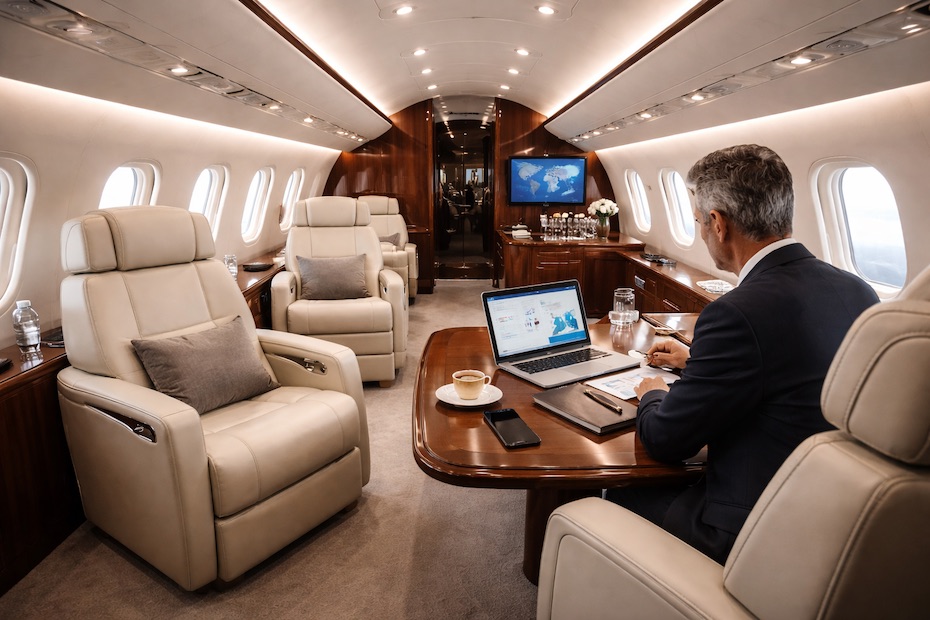
Private jet productivity gives you a measurable advantage by converting travel hours into focused working time while removing delays, distractions, and rigid airline schedules. When you fly private, productivity no longer pauses at the airport gate.
This article explains how private aviation supports executive performance in the air and on the ground. You’ll see how CEOs structure travel to protect time, sharpen decisions, and extend their working day without burnout, using real operational realities rather than theory.
What makes private jet travel a productivity tool for CEOs?
Private jet travel becomes a productivity tool because you control every variable that usually disrupts work. Departure times align with your calendar, not airline blocks. Boarding happens in minutes, which keeps momentum intact before and after meetings.
You avoid crowded terminals, unpredictable delays, and fixed seating that limits movement and focus. This control creates a predictable work environment where planning remains intact. Predictability supports performance, especially for leaders managing multiple priorities in short windows.
Executives who fly private treat the aircraft as an extension of the office. You arrive prepared, work while airborne, and land ready to act. That continuity turns travel into a strategic asset rather than a logistical burden.
How does flying private reclaim executive time?
Flying private reclaims time by eliminating waiting, rerouting, and unnecessary overnight stays. You arrive closer to your destination using regional airports that commercial flights rarely serve. That reduction in ground travel alone can recover hours on a single trip.
Commercial first or business class still requires early arrival, security queues, and boarding delays. Priority lanes shorten waits but do not remove them. Missed connections and schedule changes remain out of your control.
When travel compresses into tighter windows, you fit more meetings into fewer days. CEOs who fly private often complete multi-city itineraries in a single day that would take two or three days commercially. Time saved compounds across the year.
Why does in-flight focus improve decision quality?
In-flight focus improves decision quality because private cabins remove interruptions. You work without announcements, foot traffic, or neighboring passengers. That quiet environment supports concentration on complex material.
You can review financials, negotiate terms, or prepare strategy without pausing conversations. Discussions stay confidential, which protects sensitive information. Teams collaborate freely without concern about who might overhear.
This focused environment supports better outcomes. Decisions made without distraction tend to be faster and more precise. For CEOs handling high-stakes matters, that clarity directly affects results.
How do CEOs structure work inside a private jet cabin?
CEOs structure work inside a private jet by dividing time intentionally. Short flights often handle calls, reviews, and planning. Longer legs support deeper work sessions or team meetings.
Cabins adapt to your needs with configurable seating and tables. You move from discussion to documentation without disruption. Connectivity supports live communication when required.
This structure keeps work flowing rather than fragmented. Instead of cramming tasks between gates or after arrival, you handle them in sequence. That rhythm reduces mental load and preserves energy.
Why does schedule flexibility drive competitive advantage?
Schedule flexibility drives advantage because you respond faster to changing conditions. You adjust departure times when meetings shift. You leave early when opportunities open.
Commercial schedules rarely match executive realities. Flights depart when airlines decide, not when deals close. That mismatch creates delays that cost momentum.
With private aviation, your schedule stays aligned with business needs. You meet clients on their terms and return without delay. That responsiveness strengthens relationships and execution speed.
How does privacy protect executive productivity?
Privacy protects productivity by allowing open discussion and uninterrupted work. On a private jet, every seat belongs to your team or guests. Conversations remain internal.
Commercial cabins expose leaders to noise and proximity. Even premium seating cannot prevent interruptions or overheard exchanges. That limits what you can safely discuss.
Private aviation removes that risk. You plan, debate, and decide without filtering language or timing. That freedom accelerates progress and reduces follow-up work later.
Does flying private reduce executive fatigue?
Flying private reduces fatigue by simplifying the travel experience. You avoid long walks, security stress, and crowded boarding areas. That conserves physical and mental energy.
Cabin comfort supports posture, movement, and rest. You manage lighting, temperature, and pacing to suit your needs. These factors matter when travel days stack back-to-back.
Arriving rested improves performance immediately. You step into meetings alert rather than depleted. That difference shows in negotiation strength and decision confidence.
How does private aviation change cost calculations?
Private aviation changes cost calculations by shifting focus from ticket price to outcomes. Charter rates exceed commercial fares on paper. The comparison shifts when you factor in time recovered and opportunities secured.
One private flight can replace multiple commercial segments. That removes hotel nights, additional transport, and downtime. Teams travel together, which reduces coordination gaps.
When leadership time holds high value, efficiency becomes the metric that matters. Private jet productivity aligns cost with return rather than expense alone.
What role does private aviation play in deal execution?
Private aviation supports deal execution by keeping momentum intact. You move quickly between stakeholders without scheduling friction. That speed maintains negotiation leverage.
Delays often weaken outcomes. When timelines stretch, priorities shift. Private travel keeps discussions active and focused.
CEOs use private jets to close distance fast. You show up prepared and responsive, which signals commitment. That presence can tip negotiations in your favor.
How does flying private boost CEO productivity?
- Cuts waiting and delays
- Enables focused in-flight work
- Protects privacy for decisions
- Expands scheduling flexibility
Turn Travel Time Into Leadership Advantage
Flying private reshapes how you use time, energy, and focus as a leader. You replace passive travel with active execution and protect momentum across demanding schedules. Private jet productivity supports sharper decisions, stronger relationships, and faster outcomes. When your travel aligns with your role, performance follows. If you want more executive insights on productivity, leadership, and strategic travel, visit my profile to explore additional posts and perspectives.

Robert Wilkos is the co-founder of VIPJets.com and a private aviation executive leading luxury charter services through a global network of 10,000+ aircraft. He champions rigorous Wyvern/ARGUS safety standards, 24/7 concierge support, and flexible options like the 25-Hour Jet Card, along with ground and air-medical transport.