
Airports are becoming faster, smarter, and easier to move through because digital systems now handle more of the work that once created lines, confusion, and repeated document checks. You can already see the shift in biometric screening, mobile identity, automated bag handling, predictive queue management, and connected operations platforms.
If you want to understand where airport operations are heading, this article gives you the practical view: which technologies are gaining ground, why they matter for throughput and passenger comfort, and where the real gains come from. You will also see where execution still matters most, especially when airports need to balance speed, trust, staffing, and service quality.
Trend 1: Biometrics Are Turning Identity Checks Into Faster Passenger Flow
Biometric processing has moved far beyond trial status. Across the airport journey, facial recognition is now being used to verify identity at check-in, bag drop, security touchpoints, border control, and boarding. That matters because every repeated document check adds friction, and friction is what slows terminals down during peak demand.
From an operational standpoint, biometrics work best when they remove handoffs between disconnected checkpoints. Instead of asking passengers to stop, present documents, wait for visual review, and move again, airports can shift to a flow model where the identity check happens almost instantly in the background. When that works well, you cut queue dwell time, reduce pressure on front-line staff, and create a smoother curb-to-gate experience.
Industry and government programs show why this trend keeps accelerating. International Air Transport Association survey findings point to growing passenger use of biometrics and strong satisfaction among travelers who have already used it. United States Customs and Border Protection has also expanded facial comparison across a large number of airport entry points, which shows this is now part of mainstream airport processing rather than a niche premium feature.
Passenger comfort improves when the process feels predictable. Nobody enjoys stopping five times to prove the same identity. A biometric corridor reduces that repetition. The gain is not just speed on a stopwatch. It is lower stress, fewer moments of uncertainty, and a more consistent experience for people who are already managing timing, baggage, family, and flight changes.
Execution still determines whether the technology earns trust. Airports that deploy biometrics well make participation clear, explain data handling in plain language, and keep staffed alternatives visible. Airports that treat it like a silent back-end upgrade risk creating speed without reassurance, and that weakens the experience even if throughput improves.
Trend 2: Digital Identity Is Pushing Airports Toward A Ready-To-Fly Model
Digital identity is changing the airport from a document-checking site into a validation site. That distinction matters. When a traveler’s credentials are verified earlier in the journey, the airport no longer needs to rely on repeated manual checks at every stage. The process becomes lighter, faster, and easier to manage at scale.
This is where mobile travel credentials, digital wallets, and identity programs linked to airline and border systems start to matter. Travelers increasingly want one mobile environment that stores booking details, travel credentials, loyalty information, and payment tools in the same place. Airports benefit from that demand because a phone-based travel journey reduces dependency on paper, counters, and fragmented processing rules.
International Air Transport Association One ID work points directly to this direction of travel. The aim is simple: passengers share verified credentials before arrival, then move through the airport with less need to repeatedly show documents. For airport operators, that opens the door to shorter queues, fewer exception points, and better use of terminal space. For passengers, it means less interruption and fewer moments where the process feels uncertain.
You should also pay attention to what digital identity means for expansion planning. Building larger terminals is expensive, slow, and often constrained by land, regulation, and surrounding infrastructure. Digital identity lets airports create more capacity through process efficiency rather than only through construction. That is one of the strongest reasons this trend will keep moving forward.
The real pressure point is interoperability. A digital identity system only delivers scale when airlines, airports, border agencies, and technology providers trust the same credentials and standards. The airports that gain the most will be the ones connected to shared identity rails, not the ones running isolated pilots that stop at the terminal boundary.
Trend 3: Self-Service Kiosks And Automated Bag Drop Are Becoming Standard Capacity Tools
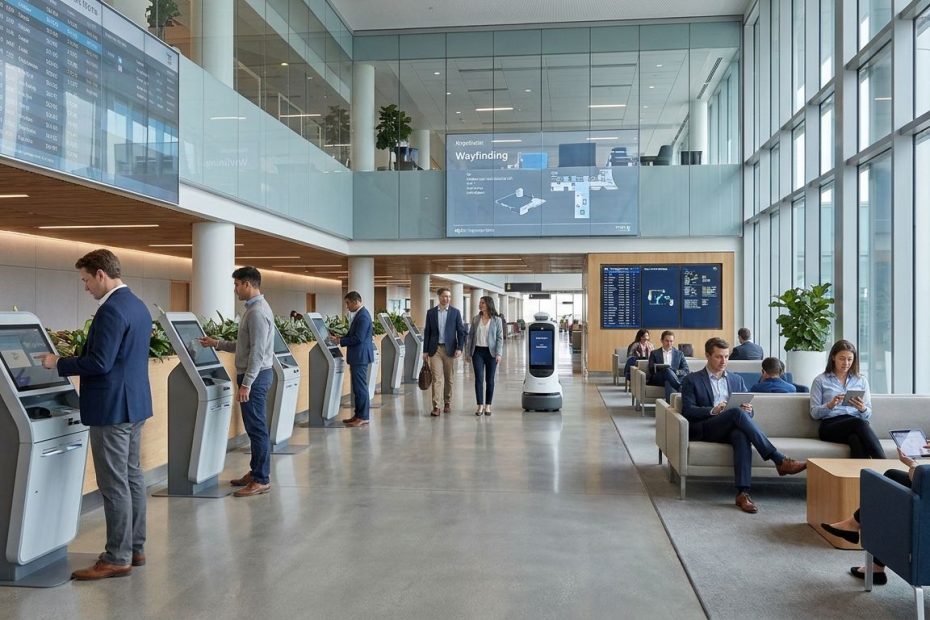
Self-service kiosks and automated bag drops are no longer positioned as convenience extras. They are now part of the operating model at many airports. When routine transactions shift away from staffed counters, terminal flow changes in a measurable way. Queues stabilize, counters handle fewer low-value interactions, and staff can focus on exceptions that actually need human judgment.
That matters because airport congestion often starts with uneven demand at check-in and baggage handoff. One delayed family, one fare issue, one oversized bag, or one passport query can disrupt an entire counter line. Automated systems reduce that chain reaction by moving standard transactions into faster, more predictable channels. The result is not the removal of people. It is better use of people.
Airport technology research from SITA shows broad deployment of kiosks and automated bag-drop infrastructure across airports. That level of adoption matters. Once a technology becomes common in the terminal environment, it stops being a differentiator and starts becoming baseline operating equipment. If an airport still treats kiosk deployment as optional modernization, it is already behind where passenger processing is heading.
The comfort benefit is easy to miss if you only look at labor savings. Passengers value control. A self-service station lets them confirm details, print tags, and move on at their own pace. When the interface is designed properly, that reduces the stop-start frustration people feel in long staffed queues where they have little visibility into how long the process will take.
The best airports combine self-service and visible support. Staff circulate near kiosks, solve problems early, and prevent small issues from turning into delays. That model performs better than a fully unattended bank of machines. The technology handles volume, and the human team protects flow quality.
Trend 4: Electronic Bag Tags And Baggage Digitization Are Reducing Friction Beyond The Counter
Baggage remains one of the most sensitive parts of the airport journey. Passengers can tolerate a short delay at screening more easily than uncertainty about where their bags are, whether the tags were applied correctly, or whether the transfer will hold. That is why baggage digitization matters so much. It removes ambiguity from one of the biggest sources of travel stress.
Electronic bag tags are part of that shift. Instead of relying only on printed paper tags that are generated at the airport, connected baggage tools allow tag information to update digitally and integrate more smoothly with self-service drop processes. This reduces manual handling, minimizes tag errors, and shortens the time spent at bag-drop stations.
The larger gain comes from end-to-end visibility. When baggage systems connect passenger identity, flight details, handoff points, and status updates in real time, airports and airlines can respond faster to exceptions. Missed connections, reroutes, and irregular operations become easier to manage when the bag is visible within the same digital chain as the passenger journey.
For passengers, baggage comfort has little to do with the mechanics of the belt system. It comes down to confidence. If a traveler knows the bag was accepted, tagged correctly, tracked through the system, and matched to the right flight, the journey feels under control. Airports that digitize baggage well reduce one of the most stubborn friction points in modern travel.
This area will keep gaining investment because baggage systems affect more than customer satisfaction. They also shape labor efficiency, reclaim congestion, transfer performance, and disruption recovery. When airports talk about smoother passenger flow, baggage is always part of that story, whether or not it gets top billing.
Trend 5: Artificial Intelligence And Real-Time Analytics Are Reshaping Queue Management
Artificial intelligence is delivering some of its strongest airport value in queue prediction and flow management. You do not need flashy passenger-facing tools to improve terminal performance. What matters is whether the airport can detect congestion forming early enough to act before the queue becomes visible, disruptive, and expensive to recover.
That is where real-time analytics, camera-based flow monitoring, sensors, and predictive staffing models come into play. Airports can now monitor how quickly passengers move through check-in, security, immigration, concessions, and boarding areas, then use that information to adjust resources. If one checkpoint starts to fill, managers can open lanes faster, reposition staff, or redirect traffic before delays spread across the terminal.
Examples from airport technology deployments show this clearly. Flow-monitoring systems built around sensor networks and light detection and ranging tools are being used to measure wait times and crowding levels in departure areas. The benefit is not just measurement. It is earlier intervention. That distinction separates useful analytics from passive dashboards that report problems after the line has already formed.
You should read this trend as an operations story, not a gadget story. Queue management is one of the clearest ways digital tools improve both efficiency and comfort at the same time. When wait times become more predictable, passengers feel less anxious and terminal teams gain more control over service levels.
The strongest airports will connect queue data to staffing systems, flight schedules, turnaround activity, passenger messaging, and security operations. Once those signals work together, the airport starts functioning as one coordinated environment rather than a set of isolated departments reacting to the same problem from different angles.
Trend 6: Off-Airport Check-In And Remote Bag Drop Are Expanding The Airport Beyond The Terminal
One of the most practical digital shifts in aviation is the move to complete more travel steps before a passenger reaches the terminal. Off-airport check-in and remote bag drop support that shift by moving processing tasks into city locations, hotels, transit hubs, or earlier mobile checkpoints. This does not just automate airport work. It relocates airport work.
That matters for capacity planning. Terminal congestion is not only a function of passenger volume. It is also a function of how many tasks still need to happen once people arrive. If check-in, identity validation, and bag acceptance can happen earlier, the terminal becomes a lighter-touch transfer point rather than the place where every process starts at once.
Industry passenger research shows rising interest in the ready-to-fly model, where travelers want fewer formalities left to complete at the airport. This preference aligns with digital identity programs, mobile credentials, and off-site processing services. The future airport experience will begin much earlier than the security queue. It will begin on the phone, in a city terminal, or at a designated processing point before the traveler even reaches the airport road system.
Passenger comfort improves because early processing changes the emotional rhythm of the trip. A traveler arriving with check-in done and bags already handled moves through the airport with more certainty and less pressure. Airports gain shorter front-end queues, better use of curbside space, and less compression during peak departure windows.
This trend will be especially valuable for high-volume airports with limited room to expand. If physical growth is constrained, process relocation becomes one of the few available ways to create new capacity without waiting for major construction programs.
Trend 7: Integrated Airport Operations Platforms Are Breaking Down Process Silos
Airports have long struggled with fragmented systems. Airlines, security teams, ground handlers, concession operators, border agencies, and terminal managers often work with different data feeds, different timelines, and different operating priorities. Integrated operations platforms address that problem by creating a shared operational view across the airport environment.
When this works well, disruption becomes easier to manage. A gate change, a late inbound aircraft, a staffing gap at security, or an unexpected passenger surge no longer sits inside one isolated system. The information becomes visible across connected teams, which allows faster decisions on staffing, messaging, stand allocation, queue control, and passenger flow.
This trend matters more than many visible front-end tools because connected operations drive the quality of everything passengers notice. A traveler may appreciate a smooth biometric boarding gate, yet the full experience still breaks down if baggage, gate management, and passenger communication are disconnected. Digital maturity in airports is measured less by how many devices are visible and more by how well the back-end systems exchange usable data.
SITA airport technology reporting points to continued investment in digital platforms, automation, and infrastructure that support shared operational awareness. That should not be read as a software procurement story alone. It is an operating discipline story. Airports that unify data make better decisions faster, and speed of decision matters when passenger volumes spike or schedules shift.
If you are watching where airport leadership teams are placing serious operational bets, this is one of the strongest areas to monitor. Integrated platforms make every other digital trend more valuable because they connect local gains into system-wide performance improvements.
Trend 8: Cybersecurity And Trust-By-Design Are Becoming Core Parts Of Passenger Comfort
As airports digitize identity, baggage, operations, and mobile journeys, cybersecurity moves from an information technology concern into a direct passenger-experience issue. A secure airport is not just one that keeps systems online. It is one that protects identity data, preserves service continuity, and prevents digital friction from turning into operational disruption.
This matters because modern airports depend on connected systems across check-in, boarding, border processing, concessions, baggage, and communications. A failure in one layer can spread fast across the passenger journey. That is why trust-by-design has become part of digital planning. Airports cannot ask passengers to adopt biometric identity, digital credentials, and mobile processing if they do not also show control over privacy, retention rules, and system resilience.
Passenger comfort is tied closely to confidence. People move more easily through digital channels when the rules are visible and the process feels managed. Strong cybersecurity supports that confidence in practical ways: stable operations, fewer outages, clearer data handling, and lower risk of service interruptions during high-volume periods.
This is also where digital adoption can stall if the airport gets the details wrong. Travelers may accept advanced processing tools when the value is clear and the rules are transparent. They push back when data collection feels vague, compulsory, or poorly explained. That makes trust-by-design an operating requirement, not a branding message.
The airports that stand out over the next few years will be the ones that treat privacy controls, resilience planning, and digital governance as part of comfort and efficiency. Those areas are no longer separate. They are tied directly to whether passengers keep using the digital channels airports want them to use.
What Do These Trends Mean For Airport Strategy And Passenger Experience?
When you put these eight trends together, a clear pattern emerges. Airports are moving toward journeys that are mobile-led, identity-aware, data-connected, and less dependent on static counters and repeated checks. The goal is not to fill terminals with technology for its own sake. The goal is to reduce idle time, compress queue pressure, and make the passenger journey feel more controlled from start to finish.
You can also see that passenger comfort is no longer limited to seating, retail mix, or terminal design. Comfort now includes certainty. It includes knowing where to go, how long a process will take, whether a bag is moving correctly, and whether a digital identity check will work without confusion. Airports that improve these operational moments create a better experience without needing to overstate the role of visible luxury.
From a leadership standpoint, the strongest digital programs share a common trait: they connect process improvement to measurable operational outcomes. Faster throughput, lower queue variance, fewer exception cases, better staffing allocation, stronger baggage visibility, and more reliable passenger communication all point to one thing. Good airport technology is operational discipline made visible.
You should also expect uneven adoption across regions and airport types. Large hubs, international gateways, and airports with strong airline partnerships will continue moving first. Smaller airports may adopt more selectively, focusing on self-service, mobile communication, and queue intelligence before investing in full digital identity chains. That does not change the direction of travel. It only changes the pace.
What Digital Trends Are Shaping The Future Of Airports?
- Biometrics speed up identity checks and boarding flow.
- Digital identity reduces repeated document handling.
- Self-service and automated bag drop cut counter congestion.
- Artificial intelligence improves queue prediction and staffing.
- Integrated data platforms make airport operations more coordinated.
Where Smart Airports Win From Here
The future airport is not defined by one machine, one app, or one checkpoint upgrade. You will see the biggest gains where airports connect biometrics, digital identity, self-service, baggage visibility, predictive analytics, remote processing, shared operations data, and cybersecurity into one disciplined operating model. That is how terminals handle more volume without letting the experience feel more crowded or more confusing. The airports that lead will be the ones that reduce friction at every handoff, keep support visible when passengers need it, and turn digital systems into smoother movement rather than added complexity. If you track airport modernization with that lens, you will understand which investments improve performance and which ones merely look modern.
References
- SITA Airport Information Technology Insights report: https://www.sita.aero/globalassets/docs/surveys–reports/sita-2025-it-insights-airports-digital.pdf
- SITA Passenger Information Technology Insights: https://www.sita.aero/resources/surveys-reports/passenger-it-insights-2025/
- International Air Transport Association One ID: https://www.iata.org/en/programs/passenger/one-id/
- International Air Transport Association passenger survey release: https://www.iata.org/en/pressroom/
- United States Customs and Border Protection biometrics at airports: https://www.cbp.gov/travel/biometrics/environments/airports
- United States Customs and Border Protection Enhanced Passenger Processing: https://www.cbp.gov/travel/us-citizens/enhanced-passenger-processing-epp
- United States Customs and Border Protection biometric testing background: https://www.cbp.gov/frontline/cbp-biometric-testing
- Inter Airport Europe airport technology article: https://www.interairporteurope.com/en-gb/blog/industry-insights/airport-technology-innovation-advancements.html
- Federal Aviation Administration Next Generation Air Transportation System: https://www.faa.gov/newsroom/nextgen
- Aviation Pros summary of Airports Council International World passenger experience trends: https://www.aviationpros.com/airport-business/news/55331538/aci-world-identifies-five-passenger-experience-trends-airports-must-prepare-for-in-2026

Robert Wilkos is the co-founder of VIPJets.com and a private aviation executive leading luxury charter services through a global network of 10,000+ aircraft. He champions rigorous Wyvern/ARGUS safety standards, 24/7 concierge support, and flexible options like the 25-Hour Jet Card, along with ground and air-medical transport.