
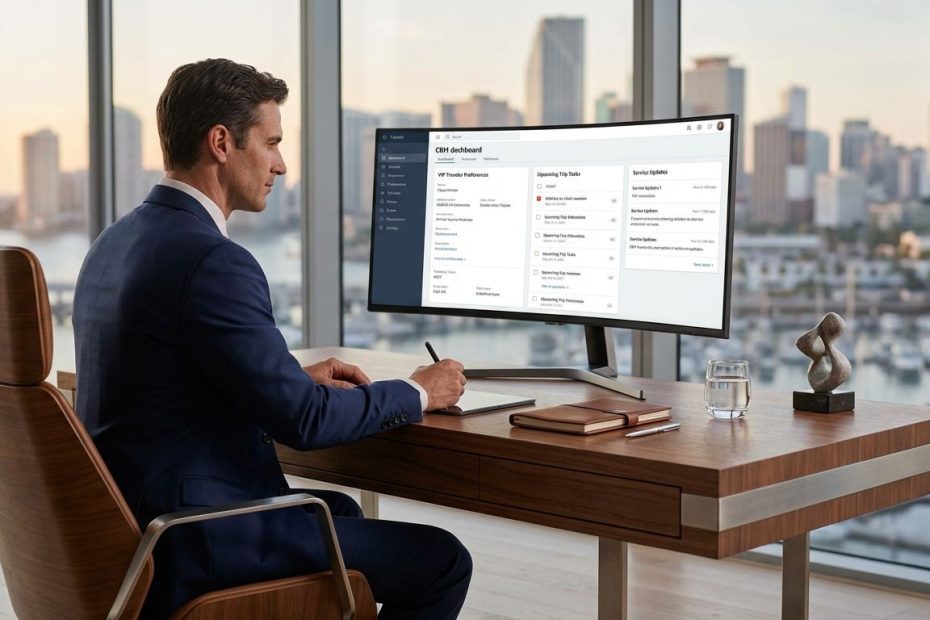
Luxury travel customer service improves fastest when your CRM does three jobs at once: it captures preference-level client intelligence, it operationalizes service with tasks and approvals, and it keeps trip communication attached to the traveler and the trip.
This guide breaks down five CRM options that consistently show up in serious luxury travel operations, from advisor-led boutiques to enterprise travel and hospitality teams. You’ll get practical selection criteria, what to watch for in pricing, and how to set up service workflows that hold up when clients are impatient, time zones are messy, and plans change without warning.
Tool 1: Salesforce Travel, Hospitality, And Transportation
If you run luxury travel like a true service business, Salesforce earns its spot when personalization must scale across teams, channels, and lines of business. You get a platform designed to unite customer data, support service teams, and create tailored experiences that feel consistent across the entire journey. That matters when you’re servicing repeat travelers who expect recognition, continuity, and fast resolution, even if a different team member picks up the thread.
The practical win is operational control. You can standardize how your team logs client preferences, service requests, exceptions, and high-stakes trip details, then tie that to reporting that actually drives staffing and training decisions. When leadership wants to know where service breaks, which segments generate the most rework, and what response-time commitments are realistic, Salesforce makes those answers measurable instead of anecdotal.
Salesforce also targets the travel and hospitality category directly, positioning its stack around connected data and AI-driven personalization for travel, transportation, and hospitality organizations. If you’re managing a multi-advisor brand, a luxury operator with multiple touchpoints, or a high-volume book of affluent repeat travelers, this category focus reduces the amount of custom duct-taping you’ll otherwise do with a generic CRM setup.
Best For: Multi-advisor luxury agencies, luxury travel operators with separate sales and service functions, hospitality-adjacent teams, high reporting and governance requirements.
Service Strength: Cross-team orchestration, enterprise-grade customer data, consistency across channels.
Tool 2: HubSpot CRM Plus Service Hub
When luxury service is treated like a real support operation, not a loose collection of inboxes, HubSpot’s Service Hub becomes a serious contender. Ticketing, shared inbox behaviors, and structured workflows push your team toward consistent response handling. That’s how you stop losing time to internal questions like “Who owns this request,” “Where is the latest document,” or “Did anyone confirm the change.”
Luxury travelers do not reward effort, they reward outcomes delivered with speed and calm. A help-desk-style service layer helps you preserve that calm under pressure. When disruptions hit, the difference between premium and forgettable service often comes down to whether your team can route, assign, and close loops with discipline. HubSpot fits that need when you want a modern service desk feel without building a heavy enterprise stack on day one.
Pricing can look friendly at the entry level and then climb as you add seats and advanced service features. That is not a flaw, it is a reality you must model early. If your luxury brand promise requires service levels that include structured routing, escalation, and accountability, plan on paying for the tier that supports those capabilities rather than forcing a Starter plan to behave like a mature service operation.
Best For: Boutique luxury agencies that want service structure, growing teams that need shared visibility, service managers who want accountability.
Service Strength: Ticketing discipline, shared inbox operations, scalable service workflows.
Tool 3: Microsoft Dynamics 365 For Travel And Hospitality Use Cases
Dynamics 365 fits luxury travel organizations that already live in Microsoft and want a CRM and service setup that integrates cleanly with existing identity, security, and productivity tooling. When your advisors and service staff operate inside Microsoft 365 all day, a Microsoft-aligned CRM strategy reduces friction in permissions, data management, and governance. That becomes more important as soon as you handle multiple advisors, assistants, contractors, or multi-location operations.
Microsoft also publishes reference architecture guidance aimed at travel and hospitality scenarios, which signals that integration patterns are not an afterthought. That matters when you need a CRM foundation that can connect to external travel platforms, back-office processes, analytics, and customer data tooling. Luxury travel is full of exceptions, special terms, and operational dependencies, so architectural clarity is a competitive advantage, not an IT luxury.
Dynamics can shine when your operation needs more than “contacts and notes.” It becomes a system of record for client profiles, service requests, and internal workflows, with the option to expand into customer insights and service automation. If you want a long-term platform path and your organization already trusts Microsoft for security and administration, this is a practical route.
Best For: Microsoft-centric organizations, larger agencies with governance needs, teams that expect deeper integration across business systems.
Service Strength: Governance, enterprise integration patterns, long-term platform flexibility.
Tool 4: TravelJoy
TravelJoy earns a top-five slot when you want travel-advisor workflow baked in: CRM, proposals, itineraries, forms, invoicing, and payments inside one advisor-friendly tool. Luxury service depends on speed and consistency, and tools built for travel advisors reduce the number of systems your team must juggle to deliver a polished client experience. That shows up in faster turnaround on quotes, cleaner collection of traveler details, and fewer “missing info” chases.
Pricing transparency is a standout, and in luxury travel, transparency directly protects margin. TravelJoy publishes a 7-day free trial with no credit card required, and it publishes plan pricing plus processing fees by plan. On the Starter plan, credit card processing is listed at 5% plus $0.30, ACH at 3%, and on the Pro plan, credit card processing is listed at 3.5% plus $0.30, ACH at 1.5%. Those fee differences become meaningful when clients are paying large deposits and final balances.
Payment handling is also where many luxury agencies get surprised, especially when clients insist on card payments and you want to keep your planning fee economics intact. TravelJoy’s help documentation explains payment processing plan logic and fee structures, and it also documents how client convenience fees are calculated when you pass processing fees through. When you’re serious about premium service, you still need to be serious about how money moves, how fast it settles, and what rules apply when funds are pulled for supplier payments.
Best For: Independent luxury advisors and small teams that want CRM plus client-facing workflows plus payments in one system.
Service Strength: Trip-centric execution, forms and authorizations, payment flow clarity.
Tool 5: Tern
Tern is a strong fit when you want an advisor-first CRM that feels designed around trips, client profiles, and day-to-day travel business workflows. It is frequently compared with other travel-advisor tools by working advisors because it aims to reduce tool sprawl. Luxury service depends on follow-through, and tool sprawl creates dropped details, duplicated work, and inconsistent communication across trips.
Pricing clarity also helps. Tern’s help documentation lists full-price subscriptions at $49 per month or $420 per year, and it documents agency seat pricing with volume discounts that can reach meaningful savings as your team grows. For a luxury agency owner, that seat pricing detail matters because headcount scaling is one of the first moments when “simple software” becomes a budget conversation. When you can forecast seat costs with published tiers, you can plan growth without guesswork.
The operational decision with Tern is whether its workflow aligns with how your team sells and services. Luxury advisors differ in how they build itineraries, manage tasks, and document preferences. If your service promise relies on consistent pre-trip data capture, repeatable trip checklists, and a clear owner for every client deliverable, a travel-advisor CRM like Tern can outperform general CRMs that require significant customization to speak the language of trips.
Best For: Luxury travel advisors and agencies that want an all-in-one travel-advisor workflow and predictable seat pricing as they scale.
Service Strength: Advisor-centric workflows, team seat pricing, reduced system sprawl.
What’s The Best CRM For Luxury Travel Advisors Who Need Deep Client Preferences And VIP-Level Personalization?
If VIP-level personalization is the core promise, your CRM must store preference-grade data and make it usable under time pressure. You need more than “likes luxury hotels,” you need structured fields and habits around room preferences, airline seating patterns, dietary constraints, medical notes you’re authorized to store, key dates, loyalty programs, preferred guides, and service recovery history. When your team can see that information instantly, you stop asking clients to repeat themselves, and that is where premium service becomes tangible.
Salesforce is the strongest pick when personalization must work across multiple teams and channels, supported by unified data and reporting. It is designed to connect data sources and enable real-time personalization at scale, which aligns with luxury operations that want consistent service beyond one advisor’s memory. If you run a brand where clients interact with multiple staff members, this matters more than any single feature list.
Tern and TravelJoy can still deliver deep personalization in a different way: they keep the workflow anchored to trips and traveler details, which helps advisors execute service reliably. If the operation is advisor-led and the goal is speed, clarity, and polish in trip delivery, travel-advisor CRMs often win because they reduce friction. The deciding factor is whether your personalization needs are enterprise-wide and cross-channel, or advisor-centric and trip-execution-focused.
Should You Use A Travel-Advisor CRM Or A General CRM For Luxury Travel?
A travel-advisor CRM wins when your service differentiator lives inside trip execution. You need forms, authorizations, itinerary delivery, proposal revisions, invoice handling, and trip-based tasks tied to a traveler profile. When those are native features, your team spends time servicing clients, not building workarounds. This is where TravelJoy, Tern, and Travefy-style tooling tends to feel “faster” in real life, even if enterprise CRMs look stronger on paper.
A general CRM wins when luxury travel is only one part of a broader organization, or when you need advanced governance, omnichannel service, complex reporting, and multi-department operations. If marketing, sales, service, and leadership all require a shared system with strict permissions, auditability, and advanced automation, Salesforce, HubSpot, or Dynamics can be the safer long-term base. The tradeoff is implementation effort and the risk of building something that looks perfect but slows the team down.
Choose based on the moments that define your brand. If the “luxury feeling” is delivered through flawless trip documents, clean client approvals, and proactive pre-trip readiness, prioritize travel-advisor workflow. If the “luxury feeling” is delivered through cross-channel recognition, multi-team coordination, and consistent service operations regardless of who answers, prioritize the general CRM built for scale.
Which CRM Tools Help Most During Disruptions And Speed Up Response Time?
Disruptions punish disorganization. When a client message arrives mid-connection or after a supplier cancellation, response speed depends on whether the team can find the latest trip version, see what was promised, and act with a clear owner. CRMs that attach communication, documents, tasks, and approvals to the traveler and the trip reduce search time and reduce handoff errors. This is not a “nice to have,” it is operational survival when multiple trips are live at once.
HubSpot Service Hub is strong here because ticketing forces structure. Requests become trackable work items, ownership is visible, and escalation can be designed instead of improvised. That structure supports luxury service because your client experiences confident handling, not internal chaos. When you pair that with clear internal macros for disruption workflows, you gain consistency without sounding scripted.
Travel-advisor CRMs also help in disruptions when they keep trip artifacts, authorizations, and traveler details connected. You want to open the trip record and see what matters without digging through emails and PDFs. The operational rule is simple: every disruption must create a single source of truth, and the CRM has to be the fastest path to that truth.
What CRM Works Best When You Want Proposals, Itineraries, And Payments In One Place?
When “one place” is a service requirement, TravelJoy is a direct fit because it positions itself as a membership that streamlines a travel advisor’s business with CRM, proposals, itineraries, forms, and payments. Luxury clients value clean approvals and clean documentation, and consolidating those steps into one tool reduces delays. It also reduces the chance that a client receives mixed instructions or conflicting versions of a trip plan.
Travefy’s CRM positioning also emphasizes a secure system that connects directly to trips, with client profiles, tasks and reminders, automations, and client activity logging. It highlights forms, including credit card authorizations, and it supports email integration so communication is easier to manage without leaving the tool. When itinerary delivery quality is central to your brand, that trip-connected CRM approach can keep execution tight.
“One place” still requires discipline. You need a defined process for proposal iterations, what triggers an invoice, how authorizations are stored, and where final confirmations live. A unified tool reduces tech friction, but the luxury standard comes from operational rules your team follows every time.
How Much Do Top CRM Options Cost, And What Pricing Surprises Should You Expect?
In luxury travel, the biggest pricing surprises rarely come from the subscription itself. They show up when you add seats, add service automation tiers, add onboarding fees, or pay more in processing than expected because clients insist on cards. Your CRM choice should include a cost model that matches your real booking flow: deposits, final payments, planning fees, supplier payment timing, and how often clients split payments across travelers.
TravelJoy publishes clear pricing and a 7-day free trial with no credit card required. It also publishes processing fees by plan, with Starter listing 5% plus $0.30 for cards and 3% for ACH, and Pro listing 3.5% plus $0.30 for cards and 1.5% for ACH. If your average invoice is large, those deltas can beat most subscription differences, and they can determine whether you pass fees to clients or absorb them as a brand decision.
Tern publishes full-price pricing at $49 per month or $420 per year, and it documents agency seat pricing with tiered per-seat costs that drop as seat count increases. That matters when you are building a team, because per-seat economics decide whether you can afford to staff for responsiveness. General CRMs can be cost-effective early, then escalate as you add service features and seats, so map costs to your actual service commitments rather than picking based on an entry-level headline price.
What Complaints Do Real Advisors Raise About Popular CRM And Support Tools, And How Do You Avoid Them?
Working advisors tend to complain about three recurring failures: a tool that is strong at itineraries but weak as a CRM, a “provided” CRM that creates extra work, and support that fails when the business needs urgent help. Those complaints matter in luxury travel because clients judge you by responsiveness and accuracy, not by which software you licensed. If your tool breaks your rhythm, service quality drops even when your intentions are strong.
Avoiding these issues requires a pilot that matches your real workflow. Test how quickly a new inquiry becomes a qualified client record, how traveler details are collected, how tasks are assigned, how documents are delivered, and how payment authorizations are stored. Stress-test the system with a disruption workflow: change dates, change suppliers, reissue documents, and confirm the audit trail stays readable. If the tool cannot handle that without chaos, it will fail at peak season.
Support quality must be treated as a selection criterion, not an afterthought. Set expectations with vendors early, learn how fast support responds, and learn what help looks like at your pricing tier. Luxury travel service is a promise of competent handling under pressure, so the tool’s support model becomes part of your risk management.
Which CRM Tools Actually Elevate Luxury Travel Customer Service?
- Best enterprise personalization: Salesforce, Microsoft Dynamics 365
- Best structured service workflows: HubSpot Service Hub
- Best trip-centric advisor execution: TravelJoy, Tern
- Choose based on: preference tracking depth, disruption handling speed, payment flow clarity, and predictable seat scaling
Build A CRM Stack That Clients Feel In Every Interaction
Pick your CRM the way you design a luxury itinerary: based on execution, not buzzwords. Salesforce and Dynamics 365 win when governance, cross-team operations, and scalable personalization drive the business. HubSpot Service Hub wins when you want a service desk rhythm with visible ownership and measurable response handling. TravelJoy and Tern win when you want travel-advisor-native workflows that reduce system sprawl, tighten trip delivery, and keep money movement and approvals closer to the trip record. After the tool decision, lock in operating rules for preference capture, task ownership, disruption workflows, and payment handling, then measure response time and rework weekly until the system runs clean.
References
- TravelJoy Pricing And 7-Day Free Trial
- TravelJoy Payment Processing Plans
- TravelJoy Client Convenience Fee Calculation
- Tern Agency Pricing
- Travefy CRM For Travel Agents
- Salesforce Travel, Hospitality, And Transportation
- Microsoft Learn: Dynamics 365 For Travel And Hospitality Reference Architecture
- HubSpot Service Hub Pricing Guide
- Forbes Advisor: Zoho CRM Pricing Guide
- Reddit: Which Itinerary Builder You Use And Why
- Reddit: Tern Vs TravelJoy
- Reddit: Tern Vs Travefy
- Reddit: Selecting TA At Virtuoso
- Reddit: WorldVia Preferred Partners And CRM Questions
- Reddit: Zendesk Account Managers And Support Complaints

Robert Wilkos is the co-founder of VIPJets.com and a private aviation executive leading luxury charter services through a global network of 10,000+ aircraft. He champions rigorous Wyvern/ARGUS safety standards, 24/7 concierge support, and flexible options like the 25-Hour Jet Card, along with ground and air-medical transport.