
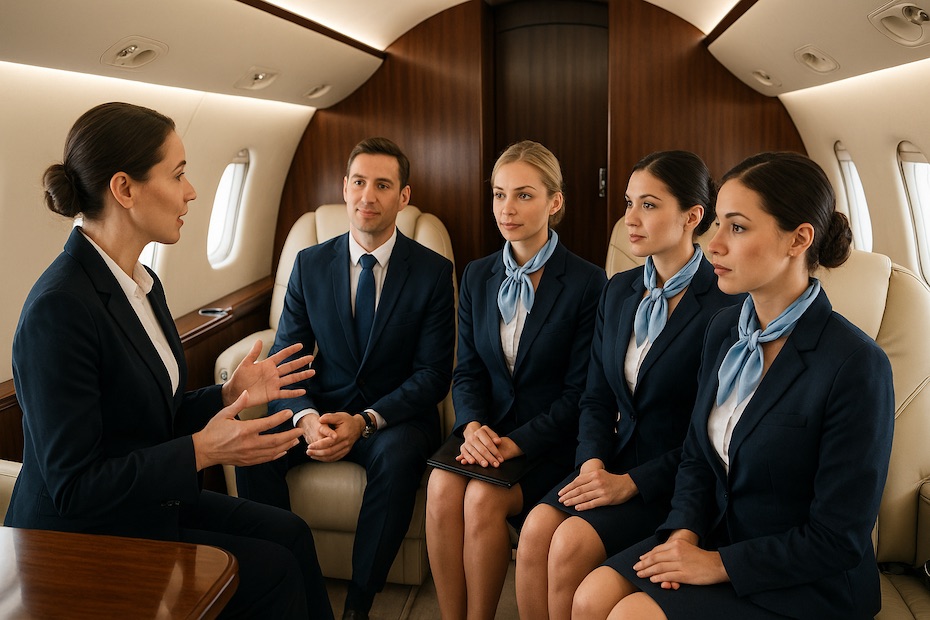
Elite private jet crews deliver unparalleled service through intensive, continuous training focused on precision, anticipation, and refinement—combining hospitality mastery with aviation safety and client psychology.
Top-tier service in private aviation doesn’t happen by chance. It’s engineered through structured training programs, performance audits, and mindset development designed to meet the standards of the world’s most discerning travelers. This article explores how you can build and sustain a crew that operates at the elite level, from technical expertise to luxury execution.
What Kind of Training Do Top Private Jet Crews Undergo?
Every elite private jet crew member completes rigorous, multi-stage training covering five pillars: safety, hospitality, culinary presentation, etiquette, and client personalization. Unlike commercial airlines, where service follows a fixed standard, private jet operations demand adaptability and ultra-personalized delivery.
The best crews often begin with specialized training providers like Corporate Flight Training (UK), offering a VIP Flight Attendant course using full-scale jet mockups. These programs combine theoretical instruction with live simulations—preparing attendants to master every variable, from guest dietary preferences to managing fine-dining service at 40,000 feet.
You’re not just building attendants—you’re developing service athletes. Training includes safety modules aligned with EASA and FAA standards, advanced emergency drills, and service etiquette designed for ultra-high-net-worth passengers. Each module emphasizes excellence under pressure—a critical skill when serving CEOs, royalty, or entertainers.
How Do Crews Tailor Their Service for Ultra-High-Net-Worth Clients?
Private jet clients expect seamless luxury from boarding to touchdown. Elite crews achieve this by embedding anticipation-based service, where every gesture and decision feels pre-emptive.
Top providers like TAG Aviation have developed specialized courses, such as the Global Service Excellence program, focusing on the art of personal recognition, spatial awareness, and unspoken communication. Training modules include tone control, privacy awareness, and timing—skills that separate the merely good from the exceptional.
As a leader, you train your crew to operate with an executive mindset. They don’t just react; they analyze guest routines, catalog preferences, and prepare personalized touches for every flight. Whether it’s a client’s preferred brand of sparkling water or a specific scent for the cabin diffuser, these subtle consistencies establish trust and elevate your reputation.
What Skills Differentiate Elite Private Jet Crew Members?
Five core skills define the world’s top private jet professionals:
- Extreme attention to guest detail
- Adaptability in unpredictable conditions
- Culinary and beverage precision
- Deep knowledge of aviation safety
- Unwavering discretion
According to InFlight Chef Delight, these competencies distinguish elite crews who can perform under pressure while maintaining composure and style. In your operation, these skills are refined through scenario-based drills. You simulate service disruptions, rapid guest requests, or altitude-adjusted catering demands to test reaction times and composure.
Your top performers develop pattern recognition—they anticipate, adapt, and execute without hesitation. That’s the level of performance that turns routine service into an exceptional experience.
How Is Performance Measured and Sustained in Private Jet Service?
Maintaining elite standards requires measurable benchmarks. Industry veterans assess crew performance through guest satisfaction scores, repeat client rates, incident reports, and internal service audits.
Companies such as Private Jet Coach specialize in on-board audits that measure punctuality, grooming, presentation, catering execution, and passenger interaction quality. In your program, you should build similar metrics—quantifying performance with objective data.
Quarterly performance reviews allow you to track each attendant’s growth, while post-flight debriefings turn guest feedback into actionable insights. Continuous learning becomes part of the culture, with refresher modules tailored to performance gaps. By treating service excellence as a measurable skill, not a subjective impression, you sustain world-class consistency year-round.
Why Culinary and Hospitality Training Is Non-Negotiable
Culinary presentation and hospitality precision are the cornerstones of elite inflight service. Guests on private jets expect meals rivaling Michelin-level dining—regardless of flight duration or galley size.
Training providers like Excellence Silver Service Training focus on silver-service plating, fine-wine etiquette, and luxury-brand knowledge. Your crew learns how to manage meal timing around turbulence, cabin temperature, and lighting, as well as how altitude subtly alters taste perception.
Onboard service refinement includes plating artistry, wine pairing, and high-altitude sensory adjustments. Crew members are trained to prepare dishes that retain visual appeal under cabin lighting, to manage delicate plating on small surfaces, and to adapt menus instantly when flight itineraries change.
Hospitality training extends beyond meals—it covers the cabin’s total sensory experience. Lighting, ambient scent, music, and temperature all fall under your crew’s performance metrics. Every variable is managed like a stage production where perfection is expected, not requested.
How Do You Build a Training Program Around the Business Athlete Mindset?
You lead your crew the way elite coaches train championship athletes—through repetition, accountability, and continuous feedback. Private aviation demands stamina, adaptability, and composure across time zones and cultures. The Business Athlete mindset treats each flight as a performance, where focus, energy, and preparation define success.
You establish measurable goals: guest-satisfaction thresholds, incident-free operation rates, and catering precision scores. Then, you schedule “training seasons” throughout the year, alternating between classroom refreshers, mock-flight simulations, and real-time scenario reviews.
Your team’s endurance matters as much as their etiquette. Crew wellness modules—covering rest cycles, hydration, and emotional regulation—keep performance consistent under demanding schedules. Mentorship rounds out the model: senior attendants guide new recruits, offering feedback and correction with the shared aim of flawless execution.
This system converts your operation into a self-improving ecosystem where discipline and pride drive excellence.
How Can You Implement This Elite Training Model in Your Operation?
Transitioning your crew from competent to elite requires structure, not slogans. Begin with a service audit—collect client feedback, evaluate performance data, and identify gaps. From there, define your premium service standards in a written document that becomes your crew’s playbook.
Next, partner with specialized providers—Corporate Flight Training, TAG Aviation, or Excellence Silver Service Training—to customize programs for your aircraft type and service model. Combine classroom modules with immersive mock-flight experiences. These simulations test your team’s coordination, precision timing, and ability to deliver under pressure.
To make this transformation sustainable, build your process around three pillars:
- Measurement: Establish KPIs for every service area, from guest greetings to catering setup time.
- Coaching: Assign mentors who review recorded service sessions and provide actionable feedback.
- Endurance: Include wellness and fatigue-management protocols to sustain quality during busy charter seasons.
Once these components are embedded, you’re not just running a training program—you’re cultivating an elite service culture. Every crew member understands their performance is both measurable and improvable, and that mindset creates exponential growth.
Key Facts About Elite Jet Crew Training
- Private jet crews train in service mastery, guest anticipation, and safety.
- Programs include culinary, etiquette, and luxury-brand modules.
- Continuous audits and feedback sustain five-star consistency.
Raising the Standard in Private Aviation
Mastery in private jet service isn’t an accident—it’s a deliberate process. You build a culture that values precision, preparation, and professionalism in every interaction. When your crew operates with athletic discipline and hospitality artistry, every flight becomes a performance worth remembering. Your guests may never see the training hours, but they’ll always feel the result.

Robert Wilkos is the co-founder of VIPJets.com and a private aviation executive leading luxury charter services through a global network of 10,000+ aircraft. He champions rigorous Wyvern/ARGUS safety standards, 24/7 concierge support, and flexible options like the 25-Hour Jet Card, along with ground and air-medical transport.